

Two people held the knowledge needed to demo the product
PaymentIQ was preparing to launch a new product. Its business development team could create opportunities and arrange meetings, but delivering the product demonstration still depended on two people: the VP of Product and one product manager.
That created a bottleneck just as the company wanted to increase activity around the launch. Every new demo request competed for the time of people whose main role was building and managing the product.
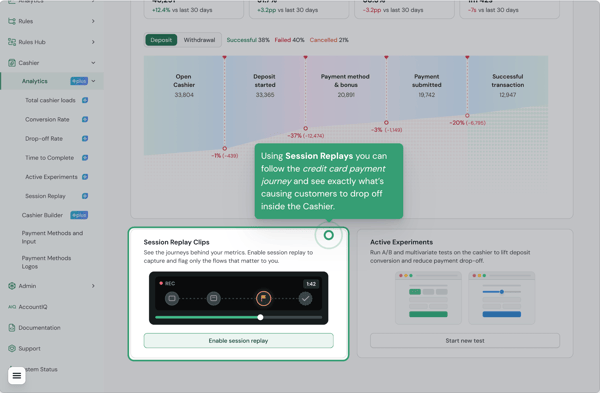
The product itself was also still evolving. Some functionality was available in the live SaaS platform. Other areas depended on transactional data held inside development environments, while parts of the new interface existed only as Figma designs.
Waiting for every feature and screen to be finished would have pushed demo production too close to the launch.
PaymentIQ needed to turn the knowledge held by its product specialists into a demo system that the wider commercial team could use repeatedly.
A demo system the wider commercial team could use
Demodia started with the people who already knew how to sell the product.
PaymentIQ's product specialists walked us through the platform as they would during a customer meeting. We captured those sessions, identified the parts that mattered to the buyer and rebuilt them as shorter, focused demonstrations.
The aim was to make that expertise repeatable rather than reproduce one long technical walkthrough.
We created a set of demo experiences that could support different conversations and different points in the buyer journey:
- Sales could access a consistent product story without requiring a product specialist for every walkthrough
- Product experiences could be created from live software, development environments or Figma depending on what was ready
- Demo registrations and engagement could feed directly into PaymentIQ's HubSpot account
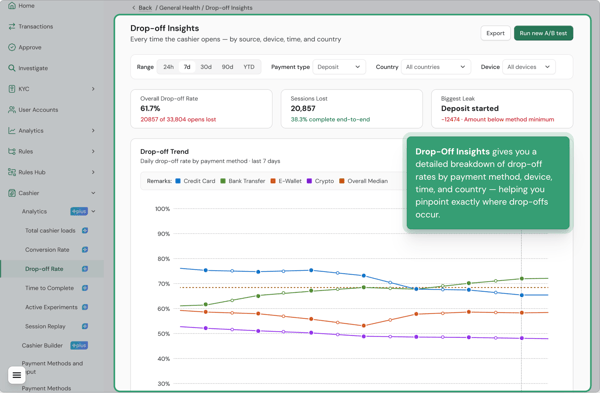
The individual demos were then organised into broader themes, giving prospects a clearer route through the parts of the product relevant to them.
Turn expert walkthroughs into reusable demos
PaymentIQ's original product walkthrough contained around 160 captured screens.
We worked through that material, removed unnecessary steps and reorganised the sequence around what somebody actually needed to understand.
The result was six to seven shorter interactive demos, each focused on a specific part of the product rather than forcing every prospect through the same lengthy technical presentation.
This gave the wider commercial team a consistent starting point while preserving the knowledge and product detail that made the original expert-led demonstration effective.
Build demos before every screen is finished
Some of the product experience PaymentIQ wanted to demonstrate had not yet reached the final live interface.
Rather than wait, we worked with their UI and UX designs in Figma and converted those flows into interactive experiences that could sit alongside demos captured from the real application.
Where data was only available inside PaymentIQ's development environment, we worked remotely with the product team to capture the required workflows.
That allowed demo production to continue alongside product development and gave PaymentIQ launch-ready experiences before every element of the final interface was available.
Connect demo engagement to the revenue process
The demos were built in Arcade and connected to PaymentIQ's HubSpot environment.
When somebody registers to view a demonstration, their details can be captured in HubSpot. PaymentIQ can then see which demos they have explored and use that information as part of the wider sales and marketing process.
The same demo assets could also be used outside scheduled sales calls. They were prepared for campaign landing pages and nurture emails, as well as self-guided experiences at PaymentIQ's industry event.
One product story could now support multiple buyer interactions rather than being recreated every time.
Launch-ready demos in weeks, with less reliance on product specialists
PaymentIQ came to Demodia shortly before its new product launch.
In less than four weeks, the company had six to seven interactive demonstrations organised into a reusable product journey.
The immediate impact was operational:
- Six to seven focused demos were ready for the product launch
- The same experiences could support sales conversations, nurture activity and events
- Registrations and demo engagement could be connected directly to contacts in HubSpot
- The wider commercial team now had a repeatable way to put the product in front of buyers without every conversation depending on one of two specialists being available.
And because the demos were built as reusable commercial assets, PaymentIQ could use the same product knowledge before, during and after a sales conversation.
You’re keeping good company
High-performing B2B software and services businesses come to us when they want to grow their pipeline.
Isn't it time for you to join them too?