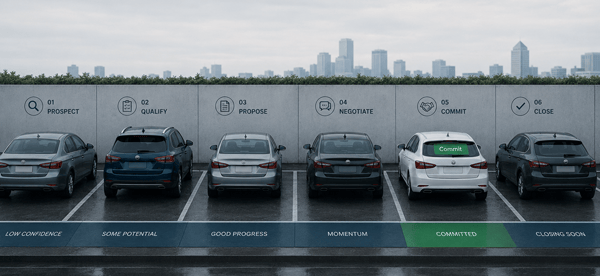
I’ve seen this moment more times than I care to admit.
A sales director opens the forecast on a Tuesday morning and something feels wrong. Nothing dramatic has happened. No one has said the deal is dead. The salesperson has not changed the forecast category. The close date is still sitting there in the CRM, looking as confident as it did last week.
But the feeling has changed.
The deal is still marked as commit, but nobody has spoken to the economic buyer. Procurement was “looped in” two weeks ago, which is one of those phrases that sounds reassuring until you ask what it actually means. The next step is a follow-up email. The champion is still friendly, but suddenly very busy.
Nobody has lied. Nobody has been lazy.
That is what makes deal slippage so frustrating. By the time everyone can see the deal is slipping, the real damage was probably done weeks ago.
The deal did not slip. The buyer stopped moving.
Deal slippage is when an opportunity expected to close in one sales period moves into a later one. In plain English, it is the deal that was meant to land this month but gets pushed into next month, next quarter, or the familiar fog of “still progressing”.
On the dashboard, deal slippage looks like a timing issue.
In reality, it is usually a control issue.
I don’t mean control in the old-fashioned sales sense, where the seller tries to drag the buyer through a process like a reluctant Labrador. I mean the business has lost sight of what is really happening. The CRM says the deal is at proposal. The salesperson says the buyer is positive. The forecast says it is coming in.
But the buyer has stopped doing things.
A salesperson can send an email. Run a demo. Issue a proposal. Update a field. Move a stage. All of that creates activity. Some of it may even be useful.
But buyer progress is different.
Buyer progress means the customer has done something that makes a decision more likely. They have agreed the problem matters. They have brought in another stakeholder. They have explained the approval route. They have booked the next meeting. They have helped build the internal case.
That is why deal slippage rarely starts at the end of the sales cycle.
It starts when we confuse our activity with their commitment.
This is usually a growing-up problem
The companies I see struggle with this are not usually chaotic. Quite often, they are good businesses.
They have grown because they know their market. The founders can sell because they understand the customer’s problem better than the customer does. The early salespeople are credible because they have lived inside the product for years. Deals happen through expertise, judgement, relationships, and a fair amount of commercial instinct.
That works brilliantly for a while.
Then the business grows.
More salespeople join. The founder steps back from every deal. The product becomes harder to explain. The buying committee gets bigger. Suddenly, the thing that used to live in a few people’s heads needs to become visible to everyone.
The company has not forgotten how to sell. It has just outgrown the informal system that used to hold the sale together.
You can feel this in forecast meetings. The experienced rep can explain a deal because they know the story behind it. They remember the buyer’s politics. They know why the timing matters. Their forecast is partly data, partly judgement, partly smell.
A newer rep looks at the CRM stages and tries to follow the process.
Discovery completed. Demo completed. Proposal sent.
It all looks right. But something important is missing.
The system records what the seller has done. It does not always show what the buyer now believes, understands, or intends to do next.
That gap is where deal slippage lives.
The warning signs are usually boring
The early signals are rarely dramatic. That is why they get missed.
A deal sits in the same stage longer than normal. The close date moves once, then again. The salesperson has one friendly contact, but no access to the person who owns the budget. The proposal has gone out before the decision process is properly understood. The next step is “follow up next week”, which is not a next step so much as a calendar entry for future disappointment.
Or the buyer says they are “reviewing internally”.
I have learned to be careful with that phrase. Sometimes it means exactly what it says. More often, it means the deal has lost energy and your champion does not yet want to have the awkward conversation.
None of these signals prove the deal is doomed.
But together, they tell you something useful: confidence has started to become guesswork.
This is where sales forecasting gets messy. A forecast should help the business see risk early enough to act. Too often, it simply reports disappointment after the fact. The deal slips, everyone updates the CRM, and the team has a very serious conversation about forecast discipline.
But forecast discipline is not the same as deal control.
You can have a perfectly updated CRM full of opportunities that are quietly going nowhere.
The six-question risk view
I’m not suggesting you solve this with a heroic new process. Nobody needs another twelve-stage sales methodology laminated into a playbook and ignored by October.
Start smaller.
Build a simple risk view around six questions. Use it in pipeline reviews. Use it before forecast calls. Use it especially for the deals everyone feels strangely confident about but cannot quite explain.
First, when did the buyer last do something meaningful?
Not when did we email them. Not when did we update the CRM. When did the buyer reply, attend a meeting, share information, introduce someone, confirm a need, or agree a next step? If a late-stage deal has had no real buyer action for two weeks, it needs attention.
Second, how many times has the close date moved?
One move can be normal. Buyers are busy. Legal takes time. Procurement departments sometimes behave as if they were designed by Kafka after a difficult lunch. Two moves should raise a flag. Three means the close date is probably no longer a forecast. It is a wish wearing a date.
Third, how long has the deal been in this stage?
Every business has a rhythm. If healthy won deals spend ten days in proposal and this one has been there for thirty-four, something has changed. The CRM stage may not have moved, but the buyer probably has.
Fourth, who is actually involved?
Single-threaded deals slip easily. If the only contact is a friendly manager who likes the product but cannot approve spend, you have hope with a business card. At some point, you need to know who owns the budget, who can block the decision, and who will live with the outcome after the contract is signed.
Fifth, what is the next real step?
“Follow up next week” is not a next step. A real next step has a date, a person, and a reason. “Commercial review with the finance director on 12 June to confirm approval route” tells you the buyer is still participating.
Sixth, what evidence proves the deal belongs in this stage?
A deal should not move forward because the salesperson completed an activity. It should move forward because the buyer has reached a new level of commitment. Discovery should mean the problem is clear. Proposal should mean the decision criteria and approval process are known. Commit should mean budget, timing, legal, and sign-off route are not being guessed.
These questions are not there to embarrass salespeople.
They are there to change the conversation from “Do you feel good about this?” to “What buyer evidence do we have?”
That one question changes everything.
The real issue is the commercial system
Deal slippage is not just a sales problem. It is usually a system problem.
Unclear messaging creates weak urgency. Weak discovery creates shallow qualification. Poorly structured demos create polite interest instead of commitment. Proposals get sent before the buyer has built consensus. CRM stages record movement, but not meaning.
Then, at the end of the month, everyone acts surprised when the deal slips.
This is why I think deal slippage is such a useful symptom. Painful, yes. Annoying, definitely. But useful.
It tells you where the business has become too dependent on individual judgement. It shows where the sales process is not visible enough. It reveals whether your CRM is helping you understand buyer progress or simply storing evidence that your team has been busy.
And it raises a bigger question.
Has your company grown beyond the informal way it used to sell?
For many B2B software and technology-enabled services companies, the answer is yes. The business has matured. The customers are more complex. The buying committees are larger. But the commercial system has not quite caught up.
The result is a pipeline that looks healthy until someone asks for proof.
Don’t wait for the slip
A slipped deal is often just the receipt for a loss of control that happened earlier.
The painful part is that the clues were probably there. They were in the lack of buyer activity, the vague next step, the missing stakeholder, the ageing stage, the proposal that went out too soon. The system just did not join the dots in time.
So pick ten deals expected to close this month and ask the six questions.
When did the buyer last do something meaningful? How many times has the close date moved? How long has the deal been in stage? Who can actually approve the spend? What is the next dated meeting? What evidence proves the deal belongs where the CRM says it does?
You will learn more from that exercise than from another polished forecast deck.
Some answers will be uncomfortable.
Good. That is where the work is.
If your forecast depends too heavily on rep judgement, late-stage optimism, and CRM fields that do not show real buyer progress, the issue is probably bigger than deal hygiene. It is a sign your sales process has outgrown the informal system behind it.
That is the kind of commercial structure we help build at Demodia: clearer messaging, stronger sales process, better buyer evidence, and a revenue system that makes complex sales easier to understand, manage, and scale. Book a diagnostic call and we can look at this together.
For companies that have outgrown informal selling, we are holding a live session that will help you identify the first commercial dependency to fix before CRM, reporting or automation can properly hold book a seat in our webinar on June 3 (3:00 PM CET) with Simon Harvey: