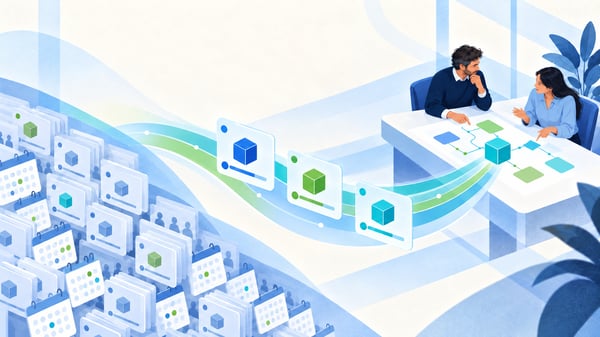
Having worked as a solution consultant for many years myself, I know what the typical weekly calendar of a pre-sales person looks like.
Pretty much every available space is taken with something. Product overview demo. Demo prep call. Follow-up demo. Stakeholder catch-up.
Then there are the emails that come in between.
“Hi, can you join our call with <name the company> tomorrow. I just need you for twenty minutes to show them the basics.”
A few of those meetings genuinely deserved a senior technical consultant on the call. But, most did not.
The worst part was that everyone knew it.
The salesperson knew the buyer was still early. The business development rep knew they mainly needed something safe to show. And I knew that I was about to explain the same process overview that I had explained yesterday, and the day before, and possibly to someone from the same account six weeks earlier.
And you know what - more than ten years later and nothing has changed…
The squeeze on sales engineering
Pre-sales teams are being asked to do more with less. Headcount is under pressure, buying committees are larger, products are more complex, and every salesperson still wants “just a quick demo” because, understandably, the buyer has asked to see the thing.
Sales and BDR teams are being pushed to cover more early-stage product education themselves. That makes sense commercially, but you cannot scale a complex sales process if every buyer has to wait for a sales engineer, or SE, before they understand the basics.
And therein lies the problem.
Sales people are not usually deep product specialists. Their skill is conversation: finding pain, creating urgency, qualifying the opportunity, keeping a deal alive when six people and one procurement spreadsheet are trying to kill it.
They should know the product well enough to sell it honestly, but they will never have the same depth as someone who lives in the product every day.
So what happens?
Sales pulls pre-sales too early. Pre-sales covers the basics. The buyer asks whether the product can do a standard thing. Everyone leaves feeling the call was useful because the product was shown. Then the same request appears again tomorrow.
This is how a sales engineering team quietly becomes a live content delivery channel.
That is a terrible use of expensive judgement. And, it's the quickest way to burn out a great team member.
The “demo monkey” problem
There is an ugly phrase you sometimes hear in pre-sales circles: “demo monkey”.
I dislike it. It sounds dismissive of a role that, when done well, has enormous commercial value. But phrases like that tend to survive because they contain a painful truth.
A good pre-sales person is not valuable because they can click through a product. They are valuable because they can listen to a buyer describe a complex process and work out what is really being asked.
They can spot when a question about a report is actually a question about board confidence. They can tell when a request for an integration is really about whether the buyer’s team will adopt the system without a fight.
That is consulting.
When you ask that person to spend half their week answering “can it do X?” questions that could have been handled by a self-guided demo, you are not just wasting time. You are dumbing down the role.
The repeatable layer should be absorbed by reusable assets. Not because assets are better than people, but because people should not be used where an asset would do the job better, more consistently, and at three in the morning when your buyer is finally doing their research.
Use-Case demos are the missing layer
This is where the Use-Case stage of the Demo Continuum earns its keep.
A Use-Case demo is a short, self-guided interactive product demo built around one buyer workflow. It is usually two to five minutes. It is not a product tour. It does not try to show everything. It takes one persona, one situation, and one recognisable problem the buyer needs to solve.
That makes it incredibly useful for reclaiming pre-sales time.
If your BDR is speaking to a revenue leader who wants to understand how your CRM handles pipeline review, they should not need an SE to walk through the basic idea. A CRM, or customer relationship management system, is simply the place where customer relationships and sales opportunities are tracked. A good Use-Case demo can show the basic flow safely: how a deal moves, how activity is recorded, how leadership sees what is happening.
The seller can then ask a better question: “Does that look like the way your team reviews pipeline, or is your process different?”
Now the buyer has context. The seller has something approved and consistent to use. pre-sales has not been dragged into an early-stage education call just to make sure nobody says something daft. We have all seen that happen. Sometimes we have been the person saying the daft thing.
The live pre-sales session, when it happens, can then focus on the buyer’s real process. Their stages. Their handoffs. Their reporting pressure. Their awkward approval route that makes complete sense internally and almost nowhere else.
That is where an SE belongs.
Repetition after the call is still repetition
Most companies think about demo waste before the live call. Fewer think about what happens afterwards.
A custom demo happens. Three people attend. Two important stakeholders do not. The champion says, “Could we show finance the approval bit?” or “Our operations lead missed the session, can we run through the workflow again?”
The default answer is another call.
Sometimes that is right. Often it is just repetition wearing a calendar invite.
I have seen teams use tools like Storylane to capture the relevant part of a custom demo after the session. Not the whole recording. Not a 58-minute Teams file that gets forwarded once and watched by nobody. A short clip or interactive follow-up that answers the specific question for the specific stakeholder.
That changes the follow-up motion completely.
Instead of asking the SE to repeat the session for everyone who missed it, you send the relevant section. The stakeholder can watch it when they are ready. The champion has something useful to pass around internally. Sales can see whether anyone engaged with it. pre-sales stays available for the next question that actually needs them.
This is not just a nice buyer experience. It is capacity management.
If five deals in a week each create one avoidable follow-up call, that is not admin. That is a hidden tax on your best technical people.
Lighter support is not worse support
There is another uncomfortable truth here. Not every opportunity deserves the same level of pre-sales support.
That sounds harsh until you admit that every sales team already behaves this way. Big strategic opportunity? Everyone appears. Small early-stage deal with vague intent? It waits, gets squeezed, or receives a generic overview because nobody has time.
The problem is not prioritisation. The problem is pretending you are not prioritising.
Reusable demos make lighter-touch support feel deliberate rather than second-class. A lower-value deal can still get a clear, accurate, buyer-led product experience. A BDR can still educate the prospect. A salesperson can still send a relevant Use-Case demo. The buyer still gets a sensible next step.
What changes is that pre-sales is no longer the default answer to every product question.
That matters when headcount is tight. It matters when your best SEs are burning out. It matters when the opportunities that genuinely need technical judgement are fighting for space with basic education calls.
A governed demo estate gives you a middle layer between “send them a brochure” and “book an SE”.
That middle layer is where a lot of scale lives.
Which demos to build first
Start by looking at where pre-sales time leaks.
Do not begin with the grand strategy deck. Open the calendar. Find the repeat meetings. Look for the same questions appearing across discovery calls, early demos and follow-ups. “Can it handle approvals?” “Can it show pipeline by region?” “Can users create their own reports?” “Can we send this to someone who missed the call?”
Those questions are your build list.
Pick the five that appear most often and decide which should become self-guided Use-Case demos, which should become short feature clips, and which genuinely require a live technical answer. Be strict. If the answer is the same for most buyers, it probably does not need to be delivered live every time.
Then give sales and BDRs a simple rule. Before asking for pre-sales, send the relevant asset and ask the buyer what they want to go deeper on. After a custom session, capture the specific section that answers the missing stakeholder’s question instead of repeating the whole meeting.
This is how pre-sales becomes more consultative, not less involved.
The SE still joins the moments that matter. They just stop being used as the world’s most expensive FAQ page.
If this sounds familiar, it is the kind of thing we help sort out at Demodia. We map where product education is sitting in the wrong place, build the Use-Case demos and follow-up assets that should carry the repeatable work, and wire them into the sales process so pre-sales can spend their time where their judgement changes the deal.
Book a demo diagnostic and we will take a look together.